
Type “GEO vs SEO” into any search bar right now and you’ll get five different definitions from five “experts,” a LinkedIn argument, and at least one person insisting GEO isn’t even a real thing yet.
It’s real. It’s just badly explained. So let’s fix that — in plain language, with zero fluff, and with everything you actually need to act on today.
Table of Contents
- The 47-Word Answer
- Wait — Haven’t We Been Doing This Since 2023?
- Why This Confusion Even Exists
- SEO vs. GEO, Side by Side
- What’s Actually Happening Under the Hood
- The Part Everyone Gets Wrong
- What Actually Changes in Your Process
- What Hasn’t Changed (Don’t Throw This Out)
- Real Examples: What Gets Cited vs What Gets Ignored
- A Simple Way to Decide Where to Focus
- The 8-Point GEO + SEO Checklist
- How to Actually Track This Instead of Guessing
- Mistakes That Quietly Kill Your AI Visibility
- FAQ
The 47-Word Answer (For Humans and AI Skimming This Page)
SEO gets your page ranked in Google’s list of blue links. GEO (Generative Engine Optimization) gets your content cited inside the AI-written answer itself — in Google AI Overviews, ChatGPT, Perplexity, and Gemini. Same internet, two different scoreboards: position vs. mention.
Bookmark that paragraph. Everything below just unpacks it.
Wait — Haven’t We Been Doing This Since 2023?
Kind of. And that’s exactly why people are confused. GEO isn’t a rebrand of SEO, and it isn’t a brand-new discipline that ignores everything you already know. It’s what happens when the output changes from a list of links to a written paragraph, and that one shift changes almost everything about how content gets chosen.
Think of it this way: SEO is auditioning for a spot on the shelf. GEO is auditioning to be the answer someone reads out loud. You can win the shelf spot and still never get quoted. You can also get quoted without ever cracking page one.
That’s the part nobody’s explaining clearly enough — so let’s make it concrete.
Why This Confusion Even Exists
Here’s the honest answer nobody wants to give you: the terminology arrived faster than the tooling did. “GEO” started circulating from research on Generative Engine Optimization, “AEO” (Answer Engine Optimization) got adopted separately by a different corner of the SEO industry, and “AIO” (AI Optimization) got used as a catch-all by agencies trying to sell a new service line. Three labels, one underlying shift.
Meanwhile, Google kept insisting — correctly — that its own AI features are “rooted in our core Search ranking and quality systems,” which sounded to a lot of marketers like “GEO is fake, just keep doing SEO.” That’s half right. It’s true for Google specifically. It’s not equally true for ChatGPT, Perplexity, or Copilot, which pull from a wider net and reward extractable structure in ways classic on-page SEO never had to think hard about.
So the confusion isn’t really about definitions. It’s about the fact that different platforms are playing by different rules at the same time, and most explainers only describe one platform’s rules while claiming to describe “AI search” as a whole.
SEO vs. GEO, Side by Side
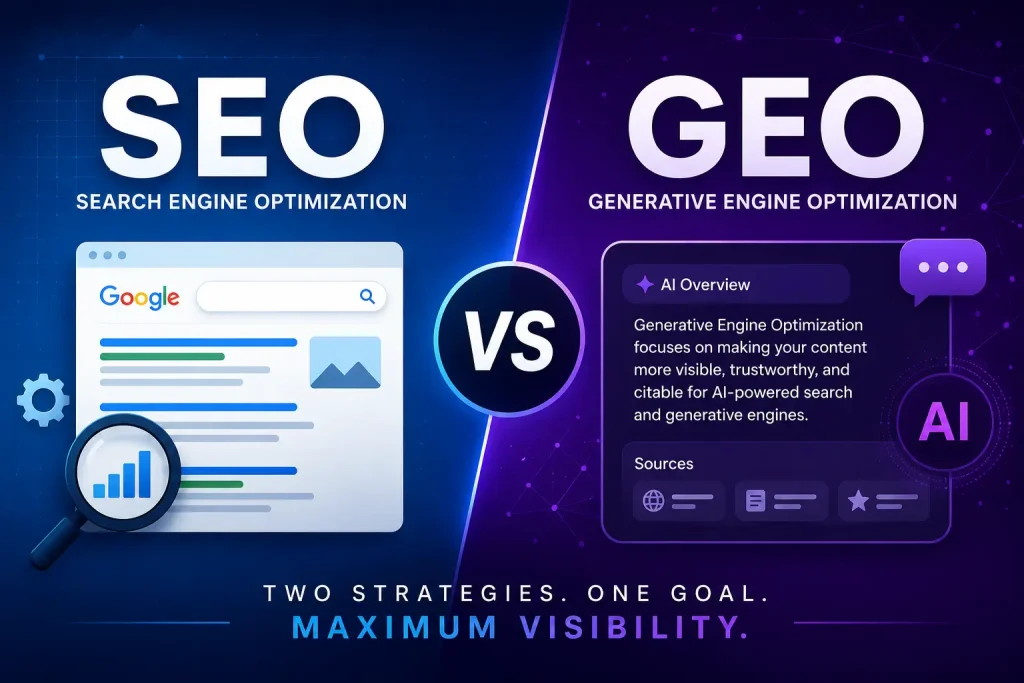
| Traditional SEO | GEO / AEO (AI Optimization) | |
|---|---|---|
| What you’re optimizing for | Ranking position (#1–10) | Being cited/quoted inside an AI answer |
| Where you “win” | The search results page | Inside the generated response, often with zero click needed |
| Success signal | Click-through rate, ranking position | Citation rate, share of AI voice, brand mentions |
| What the algorithm rewards | Backlinks, keywords, technical health, E-E-A-T | Extractable structure, clear definitions, data points, topical completeness |
| Content format that wins | Long-form, keyword-targeted pages | Comparison tables, FAQs, definition blocks, original stats |
| How it’s measured | Search Console, rank trackers | AI visibility tools (Peec AI, Otterly, ZipTie), manual prompt testing |
| Who’s the “reader”? | A person scanning a results page | A model deciding what’s worth quoting |
| Does traffic still happen? | Yes — that’s the whole point | Sometimes not at all (zero-click answers) |
Here’s the uncomfortable stat behind that last row: AI Overviews now show up in roughly 45% of Google searches, and they cut click-through to websites by as much as 58%. You can rank #1 and still watch your traffic shrink if you’re not also built to be quoted. Meanwhile, optimized content gets cited roughly 3x more often than non-optimized content covering the same topic — so the gap between “doing GEO” and “not doing GEO” is already wide and getting wider.
What’s Actually Happening Under the Hood
You don’t need to understand transformer architecture to do this well, but one mechanical detail explains almost every tactic in this article: query fan-out.
When someone asks an AI search engine a question, the system usually doesn’t just answer that one query. It silently generates several related queries behind the scenes, retrieves sources for each, and synthesizes the results into one answer. Google’s own example: someone searching “how to fix my lawn” quietly triggers fan-out searches on herbicides, chemical-free removal methods, and weed prevention — and the final answer draws from all of them.
That means a page written to rank for one narrow keyword is invisible to most of the fan-out variants an AI engine generates. A page that comprehensively covers a topic, including its natural sub-questions, gets pulled into far more of those synthesized answers. This single mechanic is why “cover the full cluster” shows up over and over again in GEO advice — it’s not a style preference, it’s how retrieval actually works.
The second mechanical detail: extraction. Google has said plainly it doesn’t want content chunked into “AI bait” fragments — write for people, in normal paragraphs and headings. But platforms like ChatGPT and Perplexity are, in practice, pulling self-contained passages out of pages to quote. A paragraph that only makes sense with three paragraphs of setup before it is much harder to lift cleanly than one that stands on its own. That’s the tension GEO lives in: write naturally for humans, but structure it so any single section could survive being extracted alone.
The Part Everyone Gets Wrong
The biggest myth going around right now is that GEO replaces SEO. It doesn’t. It sits on top of it.
Here’s why: Google has said plainly that AI Overviews and AI Mode are rooted in the same core ranking and quality systems as regular Search. There’s no secret “AI meta tag” that jumps the line. If your site isn’t indexable, isn’t trusted, and isn’t technically sound, no amount of GEO tactics will save you — because the AI is still pulling from the same index SEO built.
What actually changes is what happens after you’re in the index:
- ChatGPT, Perplexity, and Copilot behave differently from Google. They reward extractable structure — short, self-contained answer blocks; comparison tables; clearly labeled FAQs — and they cite third-party sources (Reddit threads, review sites, Wikipedia) far more than they cite brands’ own pages. In fact, brands are roughly 6.5x more likely to be cited through a third-party mention than through their own domain.
- Google’s AI Overviews correlate strongly with traditional rankings, so the fastest way to show up there is still the boring, reliable way: original information, strong E-E-A-T, and a page that already ranks well.
- Both systems increasingly run query fan-out (see above), so single-keyword pages lose ground to topically complete ones.
So the real 2026 answer isn’t “SEO vs. GEO.” It’s SEO is the floor. GEO is what happens on top of a floor that’s already solid.
What Actually Changes in Your Process
If you strip away the buzzwords, three things are genuinely different about writing for GEO:
1. You write for extraction, not just persuasion. A human reader will follow your argument down the page. A model often grabs one paragraph and leaves. That means your best insight can’t be buried in paragraph eleven — it needs to survive being pulled out of context on its own. Ask of every section: “if this were the only paragraph quoted, would it still make sense and still represent us accurately?”
2. Structure is no longer decoration — it’s a retrieval mechanism. Headings, tables, and FAQs used to be about readability. Now they’re literally how AI systems parse what your page is “about” and which chunk to quote. A wall of unstructured text is far less likely to get lifted into an answer, even if the writing is excellent. This is also why this very article uses a table of contents, a comparison table, and a toggle-style FAQ — they’re not just reader conveniences, they’re the exact shapes AI parsers latch onto.
3. Specificity beats volume. “We’re an industry leader in X” gets ignored. “Our customers cut their reporting time from 4 hours to 15 minutes” gets cited — because it’s a concrete, quotable fact, not a claim. AI systems are trained to prefer verifiable specifics over marketing language, and — this matters — keyword stuffing has been shown to actively reduce AI visibility by around 10% in controlled testing (Princeton’s GEO study), unlike in classic SEO where it was just wasted effort rather than a penalty.
What Hasn’t Changed (Don’t Throw This Out)
It’s tempting to treat GEO as a reason to abandon SEO fundamentals. Resist that. Google has been direct about this: don’t write separate content “for AI,” and don’t chop your page into disconnected fragments hoping to game extraction — that risks being flagged under the scaled content abuse policy.
The fundamentals that still carry the whole system:
- Clean, crawlable, indexable pages (AI can’t cite what it can’t read)
- Real expertise and first-hand experience behind the content (E-E-A-T)
- Fresh, dated content — undated pages lose to dated ones because recency is weighted heavily
- Genuine backlinks and third-party mentions, not manufactured ones
- Not blocking AI crawlers (GPTBot, ClaudeBot, PerplexityBot, Google-Extended) if you actually want to be cited
- Semantic HTML and fast, JS-independent rendering — both people and AI crawlers need to actually see your content, not just a loading spinner
If you’re picturing GEO as a brand-new skill tree, picture it instead as the same tree with two new branches: structure for extraction, and monitoring for citation instead of just rank.
Real Examples: What Gets Cited vs What Gets Ignored
It helps to see this in practice. Picture two competing articles on the same topic — “best project management software for small teams.”
Article A opens with three paragraphs of brand story, buries its actual recommendations halfway down the page inside dense paragraphs, never states pricing directly, and has no update date visible. It ranks on page one because of strong backlinks earned years ago.
Article B opens with a one-paragraph direct answer, follows with a comparison table (tool, price, best-for, standout feature), includes a short FAQ addressing “is there a free plan,” “what’s the cheapest option,” and “what integrates with Slack,” and shows a visible “last updated” date.
Both might rank similarly in classic SEO. But when someone asks ChatGPT “what’s a good project management tool for a 5-person team,” Article B is dramatically more likely to be the one quoted — not because it’s better writing, but because its structure matches exactly what an extraction system is built to lift out cleanly. This is the entire GEO gap in one example: same authority, same ranking, completely different citation outcome.
This also explains why some smaller, less-established sites are starting to out-cite bigger competitors on specific queries — they simply structured one page better for extraction, while the bigger brand relied on domain authority alone.
A Simple Way to Decide Where to Focus
Ask yourself one question: is my content trying to be found, or trying to be quoted? Usually the honest answer is “both” — which is good news, because the actions overlap more than they compete.
- If you’re invisible even in normal search → fix SEO first. GEO can’t save an unindexed, untrustworthy site.
- If you rank well but never see your brand named in ChatGPT or AI Overviews → that’s a structure and extractability gap. Add comparison tables, tight definition blocks, and FAQ sections to your best-ranking pages.
- If competitors are cited and you’re not, on the same topic → check whether they cover the full topical cluster (the fan-out questions) while you’re only answering the one narrow keyword.
The 8-Point GEO + SEO Checklist for Any Page
- Answer the core question in the first 40–60 words — a self-contained block a model can lift cleanly.
- Cover the topic cluster, not just one keyword — brainstorm the 5–10 related questions a fan-out search would trigger, and address each in its own section.
- Add at least one comparison table or FAQ block — the single most-cited content formats across AI platforms, at roughly a third of citations for comparison content alone.
- Back claims with specific numbers, not adjectives. “3x faster” beats “blazing fast” every time.
- Date it, and update it — freshness is now a ranking and citation signal, and stale, undated pages lose out to recently updated ones covering the same ground.
- Check you’re not blocking AI crawlers in robots.txt, and mark up the page with Article/FAQPage schema so both Google and AI systems have clean structured context to work from.
- Make each section stand alone. Read every paragraph in isolation and ask if it would still make sense — and still represent you fairly — if it were the only sentence quoted.
- Show your work. Author name, credentials, and firsthand experience aren’t just trust signals for readers; they’re E-E-A-T signals that both Google’s core ranking system and AI citation models weigh directly.
How to Actually Track This Instead of Guessing
You can’t improve what you don’t measure, and “AI visibility” doesn’t show up in Search Console the way rankings do — Google has confirmed there’s no AI-specific reporting there.
DIY monthly check (free):
- Pick your top 15–20 queries.
- Run each one through ChatGPT, Perplexity, and Google.
- Record whether you’re cited, who else is, and which of your pages (if any) got pulled.
- Log it in a spreadsheet and track the trend month over month.
If you want it automated, tools like Peec AI, Otterly AI, ZipTie, and LLMrefs monitor citation rate and “share of AI voice” across ChatGPT, Gemini, Perplexity, and Copilot continuously, so you’re not doing this by hand every time.
One important nuance: getting cited isn’t the same as getting recommended. Citation means your content was useful enough to consult. Recommendation — making an actual buyer’s shortlist — depends more on wider web consensus (reviews, forums, press) than on your own content alone. Don’t confuse a citation win with a guaranteed conversion, and don’t assume that ranking #1 today guarantees you’ll still be the cited source tomorrow — this is a moving target that rewards whoever updates and monitors most consistently.
Mistakes That Quietly Kill Your AI Visibility
- Writing a separate “AI version” of your content. Google explicitly treats this as spam risk, not a shortcut.
- Chunking pages into disconnected fragments hoping to be more “AI-friendly.” Google’s guidance is direct: don’t break content into tiny pieces — normal structure works better than artificial fragmentation.
- Gating your best content. AI systems can’t cite what they can’t access. Keep your most authoritative material open.
- Ignoring third-party presence. A mention on Reddit or a review site can out-perform your own homepage for citation purposes — don’t treat your own domain as the only channel that matters.
- No visible freshness signal. If a competing page shows “updated this month” and yours doesn’t, recency-weighting quietly works against you.
- Blocking the wrong bots. It’s fine to block training-only crawlers if you want, but blocking GPTBot, ClaudeBot, or PerplexityBot means those engines literally cannot cite you — full stop.
- Generic claims with no data. “Best-in-class support” is invisible to a citation model. “94% of tickets resolved in under an hour” is not.
- Treating this as a one-time project. AI models retrain, re-crawl, and re-rank constantly. A page optimized once in January and never revisited will quietly lose ground to competitors who keep updating theirs.