
ChatGPT vs. Claude for Marketing: The Uncomfortable Stat Behind This Whole Debate
Marketing teams have mostly stopped asking whether to use AI. The real question splitting teams in 2026 is which model to route which task to — and whether any of it is actually moving revenue.
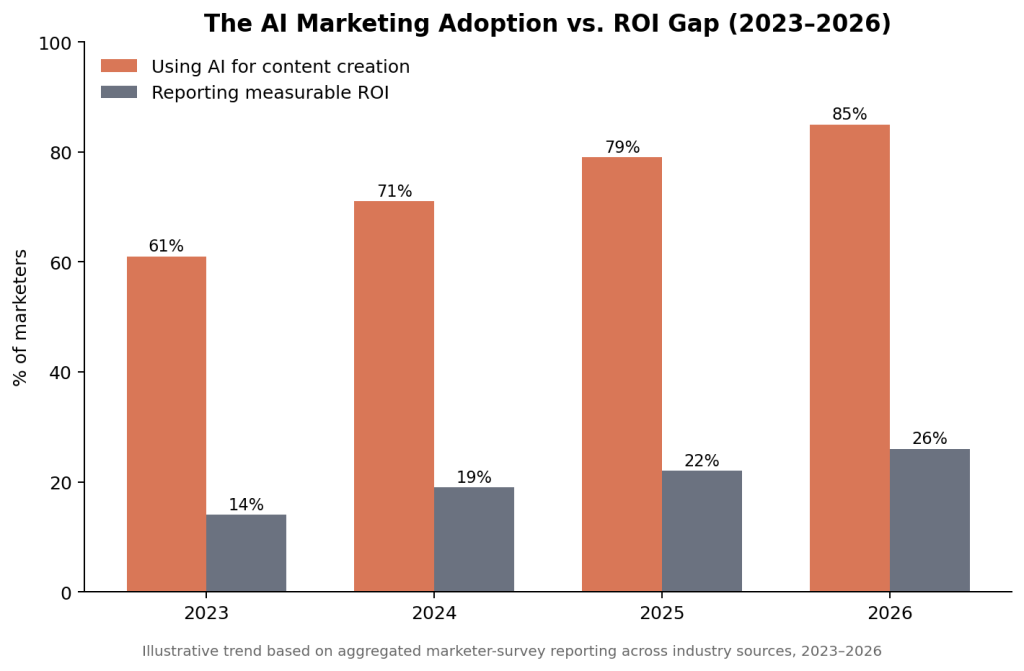
Adoption has climbed fast: roughly 85% of marketers now use AI for content creation, up from about 61% three years ago. But only around 26% say they’re seeing measurable, attributable ROI from that work. That’s not a tooling problem so much as a routing and measurement problem — teams throwing every task at one model instead of matching the task to the model that’s actually good at it.
That gap is the real subject of this post.
The Quick Verdict
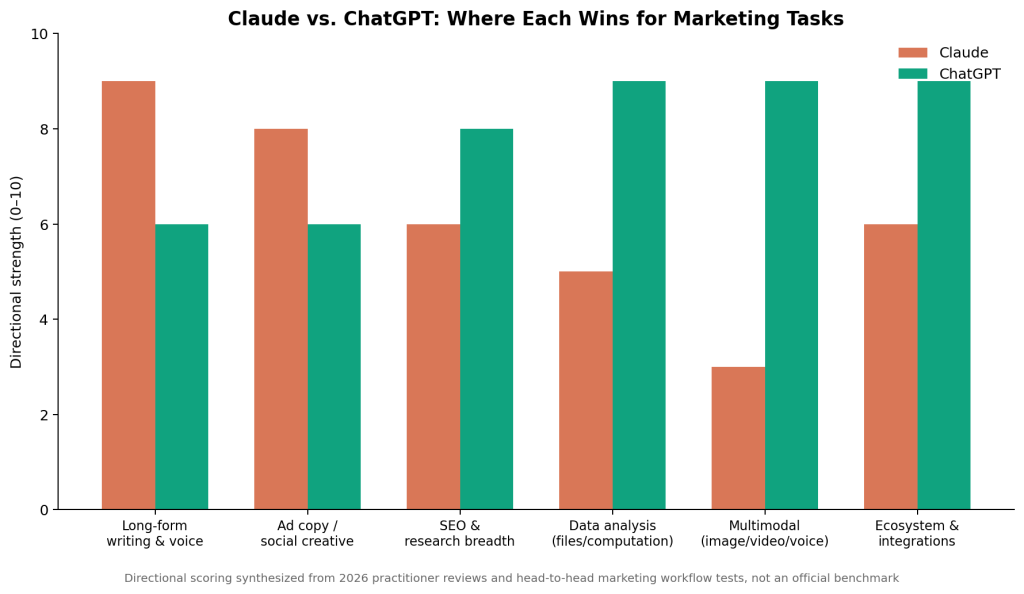
| Category | Winner | Why |
|---|---|---|
| Long-form content & brand voice | Claude | Reads less “AI-generated,” holds tone across long pieces |
| Ad copy & social creative | Claude | More natural phrasing, fewer editing passes to make it client-ready |
| SEO & competitive research breadth | ChatGPT | Native web browsing plus a wider default source pull |
| Data analysis on uploaded files | ChatGPT | Advanced Data Analysis runs real code and produces computed charts |
| Multimodal (image/video/voice) | ChatGPT | Native image generation (GPT Images), Sora video, Advanced Voice Mode |
| Long documents / large reference sets | Claude | Larger sustained context and better retention across long inputs |
| Ecosystem & integrations | ChatGPT | Broader connector library and Custom GPT ecosystem |
| Data privacy posture | Claude | Consumer conversations aren’t used for training by default |
| Price (entry tier) | Tie | Both land at $20/month for their main consumer plan |
The one-line summary you’ll hear from teams that use both daily: ChatGPT gets the reach, Claude gets the output. Neither wins every task, and that’s exactly why the highest-ROI teams don’t pick a side.
Where Claude Wins: Writing That Doesn’t Sound Like AI Wrote It
This is the most argued-about category, and also the one with the widest gap. Marketers running side-by-side tests consistently report that Claude’s prose reads more human — less templated, less prone to the generic “in today’s fast-paced world” filler that makes AI copy easy to spot.
That advantage compounds on longer pieces. Feed both tools a content brief — target keyword, audience persona, competitor URLs, brand voice guide — and Claude tends to hold a consistent voice across a 3,000-word article, while ChatGPT’s tone can drift as the piece gets longer, occasionally slipping back toward generic phrasing that needs another editing pass.
The same pattern shows up in paid creative. A number of performance-marketing teams report a specific 2026 shift: moving customer-facing ad copy — Meta ads, LinkedIn posts, email subject lines — to Claude, because scroll-stopping copy needs to sound like a person wrote it, not a template. ChatGPT, by contrast, is increasingly used for the backend of the same campaign: audience research, data cleanup, and reporting.
Practical rule of thumb: if a human is going to read the output and feel something (an ad, a landing page, a founder LinkedIn post), lean Claude. If the output feeds a dashboard or a brief, either tool is fine.
Where ChatGPT Wins: Breadth, Multimodal, and Real Computation
ChatGPT’s advantage isn’t writing quality — it’s everything wrapped around the writing.
- Multimodal production. Claude doesn’t generate images or video natively. ChatGPT ships DALL-E-based image generation, Sora video generation, and a fully-featured voice mode in the same subscription. For a team producing social creative, thumbnails, or ad variants at volume, that’s a real workflow advantage, not a nice-to-have.
- Real data analysis. If the task is “upload this customer CSV and run a cohort analysis,” ChatGPT’s Advanced Data Analysis executes actual code against the file and returns computed charts. Claude can reason about data you paste in or describe, and can execute code for analysis tasks in its own environment, but the file-upload-to-computed-output workflow is a longstanding ChatGPT strength that shows up repeatedly in head-to-head tests.
- Research breadth. For competitive intelligence that needs primary sources — SEC filings, industry reports, a wide net of citations — ChatGPT’s browsing tends to surface more sources. Claude’s edge here is synthesis: fewer sources, but sharper analysis of the ones it uses. Pick based on whether you need breadth or depth.
- Ecosystem. ChatGPT’s Custom GPTs and wider connector library make it the more natural hub if your team already lives inside a large stack of tools like the Microsoft 365 suite.
Practical rule of thumb: if the output needs a picture, a video, a computed chart from raw data, or has to slot into a big existing tool ecosystem, lean ChatGPT.
The Part Nobody Puts on the Comparison Chart: Pricing Economics
At the subscription level, the two are functionally tied — both charge $20/month for their main individual plan (Claude Pro, ChatGPT Plus), and a 5-person team lands in the same $100–150/month range on either platform’s team tier.
Where it actually diverges is API-driven automation — the workflows agencies and in-house teams build to run content pipelines, briefs, or reporting on autopilot:
- Claude Sonnet-class models price around $3 input / $15 output per million tokens; a comparable OpenAI mid-tier model runs close to that as well, so for typical marketing automation the token-rate difference is close to a rounding error.
- The gap widens at the frontier: heavier reasoning-tier models (Claude Opus-class vs. OpenAI’s top reasoning tier) can run several times more expensive per million tokens than the mid-tier options, so architecture matters — route routine tasks to a cheaper model and reserve the expensive tier for the analysis that actually needs it.
- One specific gotcha worth knowing: Claude’s API pricing has historically stepped up once input length crosses very large context thresholds (~200K tokens). If you’re building a system that chews through large content libraries or long transcripts, design around that threshold rather than discovering it in a bill.
The real ROI lesson here isn’t “Tool A is cheaper.” It’s that most of the wasted spend in AI marketing isn’t the subscription — it’s paying for a $20/month tool and then burning far more than that in human editing hours because the output landed in the wrong tool for the job. Teams that route tasks deliberately (Claude for customer-facing copy, ChatGPT for visual/data-heavy work) report needing measurably fewer editing passes than teams that force everything through one model.
Case Studies: What “Routing” Actually Looks Like in Practice
The following are illustrative composite scenarios, built from patterns reported across 2026 marketing-team write-ups and practitioner testing rather than a single named client engagement. They’re representative of what teams commonly report, not verified individual case files — use them as a template for your own A/B test, not as guaranteed results.
Case Study 1 — B2B SaaS Content Team (12-person marketing org)
The problem: A content team producing ~40 long-form articles a month was using ChatGPT exclusively. Editors were spending nearly as long “de-AI-ifying” drafts — cutting generic phrasing, fixing voice drift in the back half of articles — as they would have spent writing from scratch.
The change: First drafts moved to Claude, using a persistent brand-voice brief and a library of past top-performing articles as reference material (leaning on Claude’s larger context window to hold the whole style guide plus competitor examples in one prompt). ChatGPT stayed in the stack for keyword research and competitive scans, where its broader web browsing pulled a wider source set.
Reported outcome pattern: Teams making this specific switch commonly report needing meaningfully fewer editing passes per article and faster time from brief to publish-ready draft — the underlying driver being voice consistency, not raw generation speed.
Case Study 2 — Performance Marketing Agency (paid social)
The problem: An agency running Meta and LinkedIn ad campaigns for multiple clients found that AI-drafted ad copy tested well internally but underperformed in live A/B tests — click-through was fine, but conversion lagged, which teams attributed to copy reading as generic.
The change: Customer-facing ad copy and headline variants moved to Claude; ChatGPT stayed responsible for generating the accompanying visual assets and for structured performance reporting back to clients.
Reported outcome pattern: Agencies making this split commonly report that Claude-drafted copy needs fewer rounds of client revision to feel “on-brand,” while the combined workflow (Claude for words, ChatGPT for images) cut total production time per campaign relative to using either tool alone for everything.
Case Study 3 — SMB with No In-House Data Analyst
The problem: A small e-commerce brand wanted to understand why a Q1 ad campaign’s cost-per-result had crept up, using two years of exported ad-platform data.
The change: ChatGPT’s Advanced Data Analysis ran the actual computation on the raw export — trend lines, cost-per-result over time, computed charts. Claude was then given the output of that analysis (not the raw file) and asked to interpret it, flag likely root causes, and draft a plain-English summary for a non-technical founder.
Reported outcome pattern: This “ChatGPT computes, Claude explains” handoff is one of the most frequently repeated patterns in practitioner write-ups precisely because it plays to a real, structural difference: one tool executes code against files, the other reasons and writes about what the numbers mean.
Trends Shaping This Comparison Through the Rest of 2026
- The hybrid stack is now the default, not the exception. The “just pick one AI” framing is fading. Agencies and marketing teams increasingly run both tools with an explicit routing layer (often built in Zapier or Make) so text-heavy, customer-facing work goes to Claude and multimodal or data-heavy work goes to ChatGPT — removing the daily “which tool do I open” decision entirely.
- The adoption/ROI gap is becoming the actual KPI. With adoption near-universal, the competitive edge has shifted from “are you using AI” to “can you prove it’s working.” Expect more marketing teams to bolt on measurement layers that tie AI-assisted output back to attribution and revenue, rather than just tracking output volume.
- Enterprise trust is splitting along data-handling lines. Claude’s default of not training on consumer conversation data (a default, not an opt-in) is increasingly cited as a procurement factor for regulated or brand-sensitive industries, alongside its reputation for tighter safety guardrails on customer-facing copy.
- Both platforms are pushing further into “agentic” territory. Claude has expanded from a chat tool into a broader workspace — web search, code execution and file creation, MCP connectors to external tools, and dedicated integrations like Claude for Excel, Claude for PowerPoint, and Claude for Chrome. ChatGPT has pushed further into Agent Mode, a coding agent (Codex), and a growing connector library. The comparison is less “chatbot vs. chatbot” every quarter and more “which agent framework fits your stack.”
- Multimodal is becoming table stakes for creative production, not a bonus. As social and ad creative production scales, teams that need images, short video, or voice in the same workflow as the copy increasingly find ChatGPT’s native multimodal stack removes a tool-switching step that a text-only assistant can’t close.
- Context window arms race continues. Both companies have pushed toward roughly 1-million-token context windows on their top-tier models in 2026, which matters less for a single blog post and more for marketing teams doing brand-voice consistency across an entire content library, or synthesizing a full year of campaign data in one pass.
So, Which One Actually Delivers ROI?
Neither tool “wins” marketing outright, and any comparison that tells you otherwise is selling something. The honest answer:
- If your bottleneck is editing time on customer-facing copy — blog posts, ad copy, email, social — Claude’s voice consistency will likely save more human hours than its subscription costs, which is where real ROI shows up.
- If your bottleneck is production volume across formats — images, video, structured reports, dashboards — ChatGPT’s multimodal breadth and Advanced Data Analysis close that gap faster.
- If you’re only going to pay for one, the honest advice from teams that have tested both extensively is: pick based on your single most repeated task, not your most impressive-sounding one.
- If you can justify $40/month total, running both and routing by task is what the teams reporting the best ROI are actually doing in 2026 — the incremental subscription cost is trivial next to the editing hours it saves.
The single biggest lever for ROI isn’t which model you pick. It’s whether you measure what happens after the content ships — and stop assuming that more AI output automatically means more revenue.
Frequently Asked Questions
1. Is Claude or ChatGPT better for marketing in 2026?
Neither of these AI marketing tools wins outright. Among the best AI tools for digital marketers, Claude tends to win for customer-facing writing — AI copywriting tools use cases like ad copy, blog content, and brand voice — while ChatGPT tends to win for multimodal production, data analysis, and research breadth. Most teams getting strong AI marketing ROI use both and route tasks by strength as part of their broader AI marketing automation tools stack.
2. Which AI writes better marketing content, Claude or ChatGPT?
For AI content writing for SEO and brand-voice consistency, Claude generally produces copy that reads less “AI-generated” and holds tone better across longer pieces — a key factor in AI vs human content writing debates and in how AI generated content SEO ranking plays out in practice. ChatGPT can be faster to draft but often needs more editing passes to remove generic phrasing.
3. Can Claude generate images or videos for marketing campaigns?
No. Claude does not natively generate images or video. For teams focused on AI for social media marketing, ChatGPT’s native image generation and Sora-based video generation make it the stronger choice for visual and multimodal creative production.
4. Is ChatGPT or Claude cheaper for a marketing team?
At the subscription level they’re essentially tied — both charge around $20/month for their main individual plan, and a 5-person team lands in a similar range on either platform’s team tier. If you’re comparing Claude AI pricing against ChatGPT for a small operation, the real cost difference shows up in API-driven automation, where token pricing varies by model tier — a common consideration in AI for small business marketing.
5. Which AI is better for SEO and competitive research?
As AI tools for SEO content go, ChatGPT tends to pull a broader set of sources for competitive and market research thanks to its web browsing, which supports a stronger SEO content strategy 2026 built on breadth. Claude’s strength is synthesis — fewer sources, but sharper analysis of the material it does use.
6. Can either AI analyze marketing data from a spreadsheet or CSV?
ChatGPT’s Advanced Data Analysis can run real code against an uploaded file and return computed charts. Claude can reason about data you paste in or describe, and can execute code for analysis in its own environment, but the direct file-upload-to-computed-output workflow has historically been a ChatGPT strength — relevant for any digital marketing consultant AI tools workflow that leans on reporting.
7. Do marketing teams really need to use both ChatGPT and Claude?
Not strictly, but among AI tools for content marketing agencies, teams that use both report needing fewer editing passes and faster turnaround than teams forcing every task through a single model. If budget only allows one, pick best AI for ad copywriting needs based on your single most repeated task rather than the most impressive-sounding feature — advice that holds for most AI tools for marketing agencies India as much as anywhere else.
8. Which AI is safer for regulated or brand-sensitive industries?
Claude is often cited for a more conservative safety posture and a default of not training on consumer conversation data, which some enterprise and regulated-industry buyers weigh as a procurement factor when evaluating ChatGPT for content writing versus Claude for compliance-sensitive campaigns.
9. How is “AI marketing ROI” actually measured?
The honest answer: most teams aren’t measuring it well yet. Output volume isn’t ROI — the teams with real AI tools for content creation ROI tie AI-assisted content back to attribution and revenue, and track editing-hours saved, not just posts published. This is central to how to measure AI marketing ROI in any real budget conversation.
10. What’s the single biggest mistake marketing teams make when choosing between Claude AI for marketing and ChatGPT?
Forcing every task through one model instead of routing by strength. If you’re still asking is Claude better than ChatGPT for marketing or which AI tool for ad copy fits your team, the answer usually isn’t “either/or” — it’s building a how to use AI for marketing strategy approach around task-fit and measurement, not tool loyalty.