
By Amit Gaurav, AI Marketing Consultant, Delhi & Gurugram, India
If you’ve watched your organic traffic dip even while your rankings look “fine” in Google Search Console, you’re not imagining it. Google AI Overviews now appear on a huge share of informational searches, and they’re changing what “ranking #1” even means. A growing number of searches now end with the user reading an AI-generated summary and never clicking a single blue link.
This isn’t a reason to panic. It’s a reason to change how you optimize. Ranking in Google AI Overviews requires a different mindset than classic SEO — one that blends traditional search engine optimization (SEO) with Answer Engine Optimization (AEO), Generative Engine Optimization (GEO), and AI Optimization (AIO). In this guide, I’ll walk you through exactly how AI Overviews decide what to cite, and the specific, actionable steps you can take this week to get your content pulled into that box at the top of the page.
If you’d rather have this done for you by someone who audits sites and structures content for AI citations professionally, my AI SEO services are built exactly around this shift — real data, no guesswork.
What Are Google AI Overviews, Exactly?
Google AI Overviews are AI-generated summaries that appear at the top of the search results page, above the traditional “10 blue links.” Powered by Google’s Gemini models, they synthesize information from multiple sources to answer a user’s query directly on the results page, often with a handful of citation links to the sources it pulled from.
Unlike a classic featured snippet, which pulls one chunk of text from one page, an AI Overview can blend information from several sources into a single cohesive answer. That means you don’t just need to “win” a keyword anymore — you need your content to be one of the few sources Google’s AI trusts enough to synthesize from.
AI Overviews now reach roughly two billion monthly users worldwide, and informational queries trigger them at rates as high as 80–88% depending on the industry. Commercial and transactional queries trigger them far less often, which is actually useful information for prioritizing which content to optimize first.
Why Ranking in AI Overviews Is Different From Ranking in Google Search
Traditional SEO optimizes for relevance and authority signals that push a page toward position one. AI Overview optimization — often called GEO (Generative Engine Optimization) or AEO (Answer Engine Optimization) — optimizes for something slightly different: citation-worthiness.
Research from SEO analysts has found that traditional ranking metrics predict only a small fraction of whether content actually gets cited inside an AI Overview. In other words, being on page one of Google no longer guarantees you’ll show up in the AI-generated summary above it. Google’s AI systems are evaluating content on different dimensions:
- Clarity of structure — Can the AI easily extract a clean, self-contained answer from your page?
- Demonstrated expertise — Does the content show real experience, not just repackaged information?
- Freshness — Is the information current, dated, and regularly updated?
- Corroboration — Do multiple independent, trustworthy sources agree with your claims?
- Machine-readability — Is your content marked up with schema so search engines can parse it with confidence?
This is why two pages targeting the same keyword, with similar backlink profiles, can have wildly different AI Overview visibility. The one written like an “answer” wins over the one written like a traditional blog post.
How Google’s AI Actually Chooses What to Cite
Based on current research and observed patterns, Google’s generative search systems tend to favor sources that:
- Answer the query in the first few sentences, without burying the answer under a long introduction.
- Are backed by structured data (schema markup) that explicitly labels what the content is — an article, an FAQ, a how-to, a product, a review.
- Come from domains with consistent topical authority, not a single lucky article on an otherwise unrelated site.
- Include specific data points, statistics, and numbers rather than vague generalizations.
- Have been updated recently, since AI systems weight freshness heavily for anything time-sensitive.
- Are corroborated elsewhere on the web — a claim repeated by multiple independent authoritative sources is safer for an AI system to cite.
Roughly 44% of AI citations pull from the first third of a page’s content. That single data point should change how you write. Google’s AI isn’t reading your whole article the way a human might scroll through it — it’s scanning for the fastest, cleanest, most confident answer.
Step-by-Step: How to Optimize Your Content for AI Overviews
1. Lead with the answer, not the build-up
Every page targeting an informational query should answer the core question within the first 50–100 words. Save the storytelling, the history, and the context for after the answer. This single change is often the highest-leverage fix on an existing page.
2. Write in “answer capsules”
Break your content into self-contained chunks that could be lifted out and understood without the rest of the page. Each H2 or H3 should be a question a real user would type, followed immediately by a direct, complete answer in 2–4 sentences, then supporting detail afterward.
3. Use structured data religiously
Schema markup doesn’t guarantee an AI Overview citation, but it removes ambiguity for the crawler trying to understand your page. At minimum, mark up your content with Article, FAQ Page, How To (where relevant), BreadcrumbList and Organization schema. You can validate any markup using Schema.org’s official documentation before publishing.
4. Build topical depth, not just single articles
A single well-optimized post rarely outranks a domain that has published a genuine cluster of related, interlinked content. If AI Overviews are choosing between a site with one article on a topic and a site with fifteen interlinking articles covering every angle, the cluster usually wins on trust signals. This is the same principle behind proper AI-powered keyword clustering — grouping content by real search intent instead of guessing.
5. Show real E-E-A-T, not just claim it
Experience, Expertise, Authoritativeness, and Trustworthiness are more important in 2026 than ever, precisely because AI systems are trying to avoid citing low-quality or hallucination-prone content. Add author bios, real credentials, original data, first-hand case studies, and dated publish/update stamps.
6. Keep information fresh
For anything tied to trends, pricing, statistics, or “in [year]” content, set a recurring reminder to update the page. Stale content is one of the fastest ways to lose an AI Overview citation you previously held.
7. Earn corroboration across the web
Because AI systems favor claims that are echoed elsewhere, digital PR, guest contributions, and genuine backlinks from topically relevant sites still matter — arguably more than ever, since they signal to the AI that your claim isn’t an outlier.
8. Optimize for brand and branded search
AI systems weight brand signals heavily when deciding which source to trust. Building recognizable brand search volume — people searching your business or product name directly — is becoming a genuine ranking factor for AI visibility, not just a vanity metric.
9. Diversify beyond Google
ChatGPT, Perplexity, and Google’s own AI Mode all pull from different signals, and citation overlap between these systems is surprisingly low. Structuring your content well for AI Overviews tends to help across all of them, but don’t assume ranking in one guarantees visibility in another.
10. Track AI-specific visibility, not just clicks
Traditional rank trackers don’t show you AI Overview appearances. Start manually tracking which of your target queries trigger an AI Overview and whether you’re cited, and treat that as its own KPI separate from classic organic rankings.
SEO vs. AEO vs. GEO vs. AIO: What’s the Difference?
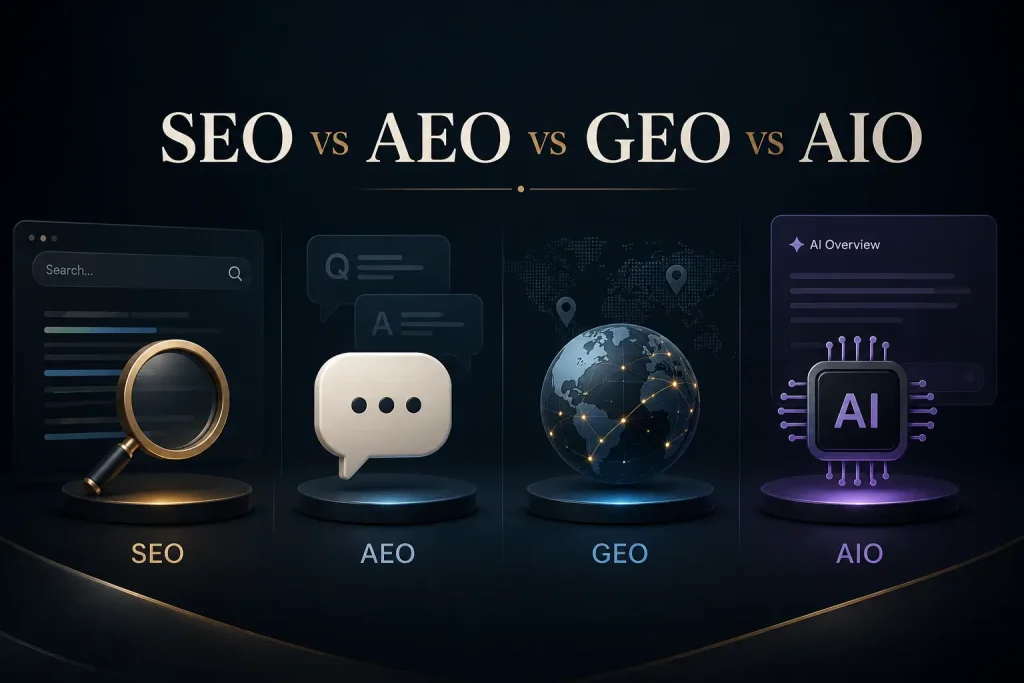
SEO, AEO, GEO, vs AIO are evolving digital marketing strategies focused on online visibility
| Discipline | What It Optimizes For | Primary Goal |
|---|---|---|
| SEO | Traditional Google ranking factors | Rank in the 10 blue links |
| AEO (Answer Engine Optimization) | Direct-answer formats for voice and answer boxes | Be the extracted answer |
| GEO (Generative Engine Optimization) | Citation-worthiness inside AI-generated summaries | Be cited inside the AI Overview / ChatGPT / Perplexity answer |
| AIO (AI Optimization) | Overall content structure and machine-readability for any AI system | Be understood and trusted by AI crawlers broadly |
These aren’t competing strategies — they’re layers. A page that’s well-optimized for classic SEO, structured for AEO, corroborated for GEO, and machine-readable for AIO gives you the broadest possible visibility across every surface where your customers are now searching.
Common Mistakes That Keep Content Out of AI Overviews
- Burying the answer. If a reader (or an AI) has to scroll past 400 words of preamble to find your point, you’ve already lost.
- Skipping schema markup entirely. This remains one of the most under-used, highest-leverage technical fixes available.
- Publishing thin, generic content that just repeats what’s already ranking, adding no new data, experience, or perspective.
- Letting content go stale. A three-year-old “best of” post with outdated numbers is an easy pass for an AI system trying to avoid outdated claims.
- Ignoring brand-building in favor of chasing only non-branded keyword volume.
- Measuring success by clicks alone, when a citation without a click can still build brand trust and downstream conversions.
How to Measure Whether It’s Working
Since AI Overview citations don’t always show up as clicks, you need a slightly different measurement approach:
- Manually search your top 20–30 target queries and log whether an AI Overview appears and whether you’re cited.
- Check Google Search Console’s newer AI-related reporting where available, which surfaces impression data for AI-generated results.
- Track branded search volume growth as a proxy for AI-driven brand exposure.
- Monitor referral traffic from AI platforms like ChatGPT and Perplexity in your analytics referral reports.
- Set a quarterly cadence to re-audit and refresh your highest-priority pages.
If you want a documented baseline before making any changes — so you can actually prove what moved and why — that’s exactly the kind of audit covered under AI Marketing Consultant Delhi, where every recommendation is backed by real data rather than assumptions.
Which Queries Are Worth Optimizing First?
Not every page on your site has the same odds of showing up in an AI Overview, so prioritization matters. Informational queries — the “what is,” “how to,” “why does” type searches — trigger AI Overviews at the highest rates, often in the 80–88% range depending on industry. Commercial queries, where someone is comparing options before buying, trigger AI Overviews far less often, and purely transactional or navigational searches (“buy,” “login,” a brand name) trigger them the least of all.
This means the fastest wins usually come from your blog, your FAQ pages, your glossary or “definitions” content, and any how-to guides you’ve already published. Product and service pages further down the funnel matter for conversion, but they’re rarely where AI Overview visibility gets won first. Audit your existing content library, sort it by query type, and start your restructuring work with the highest-volume informational pages before moving to anything transactional.
Quick Implementation Checklist
If you only have an hour this week to work on this, run through this checklist on your single highest-traffic informational page first:
- ☐ Rewrite the opening 100 words to directly answer the primary query
- ☐ Break the rest of the page into question-based H2/H3 headings, each followed by a 2–4 sentence direct answer
- ☐ Add or update
ArticleandFAQPageschema markup - ☐ Add a visible “last updated” date and refresh any outdated statistics
- ☐ Add at least one original data point, case study, or first-hand example
- ☐ Interlink to 2–3 related pages on your own site to reinforce topical depth
- ☐ Check whether the target query currently triggers an AI Overview, and note whether you’re cited
- ☐ Re-check in 4–6 weeks after Google recrawls the page
Repeat this process across your next 10–15 highest-value informational pages, and you’ll typically start seeing meaningful shifts in AI visibility within a single quarter. This is precisely the kind of prioritized, sprint-based rollout used across client engagements under AI SEO services — audit first, fix the highest-leverage pages first, then compound from there.
Final Thoughts
Ranking in Google AI Overviews isn’t a mysterious algorithmic secret — it’s a discipline of writing clear, well-structured, genuinely useful content, backing it with proper schema, and building the kind of topical authority and brand trust that AI systems are specifically designed to reward. The businesses that treat this as “SEO plus a few tweaks” will fall behind the ones that treat it as its own strategic priority.
Start with your highest-traffic informational pages, restructure them into clear answer capsules, add schema markup, and track your AI Overview appearances over the next quarter. Small, consistent changes compound faster in this space than most people expect.
Want this done properly across your whole site instead of piecing it together yourself? Get in touch for a free audit and I’ll show you exactly where your content stands today.
Frequently Asked Questions
1. What is a Google AI Overview?
A Google AI Overview is an AI-generated summary that appears at the top of Google’s search results, synthesizing information from multiple web sources to directly answer a user’s query, often with citation links to the sources used.
2. How is ranking in an AI Overview different from ranking #1 on Google?
Ranking #1 means your page appears highest in the traditional list of results. Being cited in an AI Overview means Google’s AI selected your content as a trustworthy source to synthesize its answer from, which depends more on clarity, structure, and corroboration than on classic ranking signals alone.
3. Does schema markup actually help you get cited in AI Overviews?
Schema markup doesn’t guarantee a citation, but it makes your content far easier for Google’s systems to parse and trust, which increases your chances. Article, FAQPage, HowTo, and Organization schema are among the most useful types to implement.
4. Why is my page ranking on page one but never appearing in the AI Overview?
Traditional ranking factors only predict a small portion of AI citation behavior. Your page may rank well in classic search while still lacking the clear structure, freshness, or corroboration that AI systems specifically look for when selecting sources.
5. What is the difference between SEO, AEO, GEO, and AIO?
SEO targets traditional Google rankings, AEO targets direct-answer formats, GEO targets citation-worthiness inside AI-generated summaries like AI Overviews or ChatGPT, and AIO refers to broader content structuring so any AI system can read and trust your content.
6. How long does it take to start appearing in AI Overviews?
There’s no fixed timeline, but most sites see initial movement within a few weeks to a few months after restructuring content and adding schema, depending on how frequently Google recrawls the page and how competitive the topic is.
7. Do AI Overviews reduce website traffic?
Yes, for many informational queries, AI Overviews increase zero-click search behavior since users get their answer without visiting a website. However, being cited still builds brand visibility and trust, and can drive higher-intent traffic from users who click through for more depth.
8. What content format works best for AI Overview citations?
Content structured as clear, self-contained “answer capsules” — a direct question as a heading followed immediately by a complete 2-4 sentence answer — tends to perform best, since it mirrors exactly what the AI needs to extract.
9. Can small businesses realistically compete for AI Overview visibility?
Yes. Because AI Overview citation depends heavily on content clarity, structure, and genuine expertise rather than purely on domain size or backlink volume, small businesses with well-structured, authentic content can compete effectively in their niche.
10. How do I track whether my content is appearing in AI Overviews?
Manually search your target queries to check for Google AI Overview appearances and citations, monitor Google Search Console’s AI-related reporting where available, and track referral traffic from AI platforms like ChatGPT and Perplexity in your analytics.