
SEO vs AEO vs GEO vs AIO: The Complete 2026 Guide to Getting Found by Google, ChatGPT, and AI Overviews
Search Didn’t Die. It Split Into Four Different Games.
If you’ve searched anything on Google in the last year, you’ve probably noticed you’re not always clicking a blue link anymore. Sometimes an AI Overview answers the question before you scroll. Sometimes you asked ChatGPT or Perplexity instead of opening a search engine at all. Over 60% of Google searches now end without a click to any website — the answer just… appears.
That single shift is why four acronyms have taken over marketing conversations: SEO, AEO, GEO, and AIO. They get thrown around interchangeably, which is exactly why most people are confused about what to actually do differently.
Here’s the short version before we go deep: these aren’t four competing strategies fighting for your budget. They’re four layers of the same visibility problem — being found on a results page, being quoted in a snippet, being cited by an AI model, and being recommended across the entire AI ecosystem. As a Digital Marketing Consultant in Delhi, this is the exact framework I now build into every AI SEO Services engagement, because treating them separately is how brands quietly go invisible in 2026.
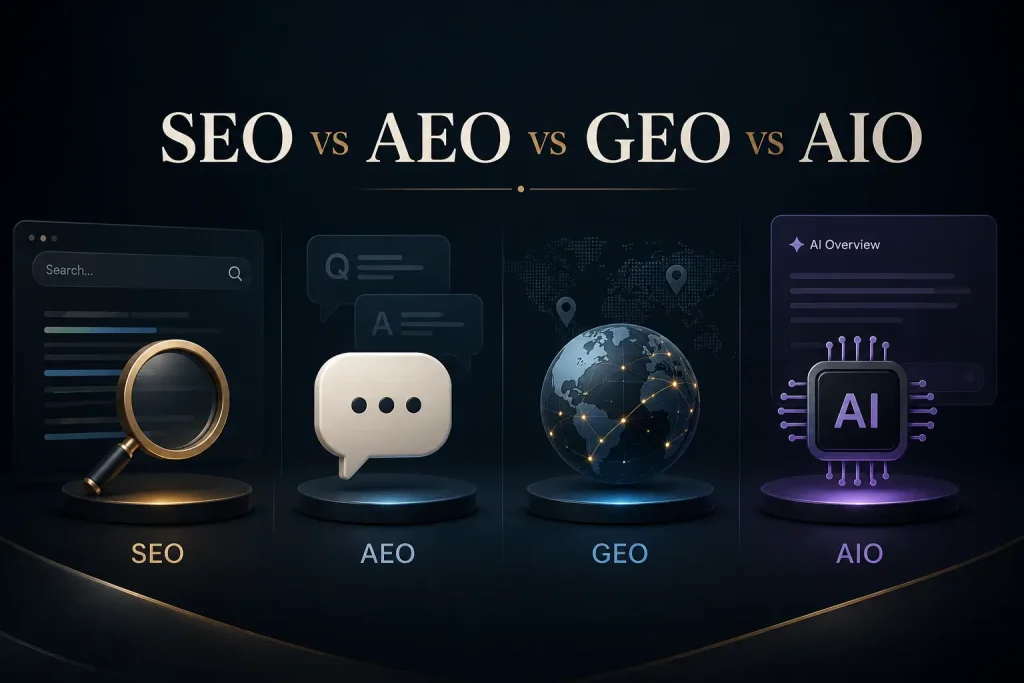
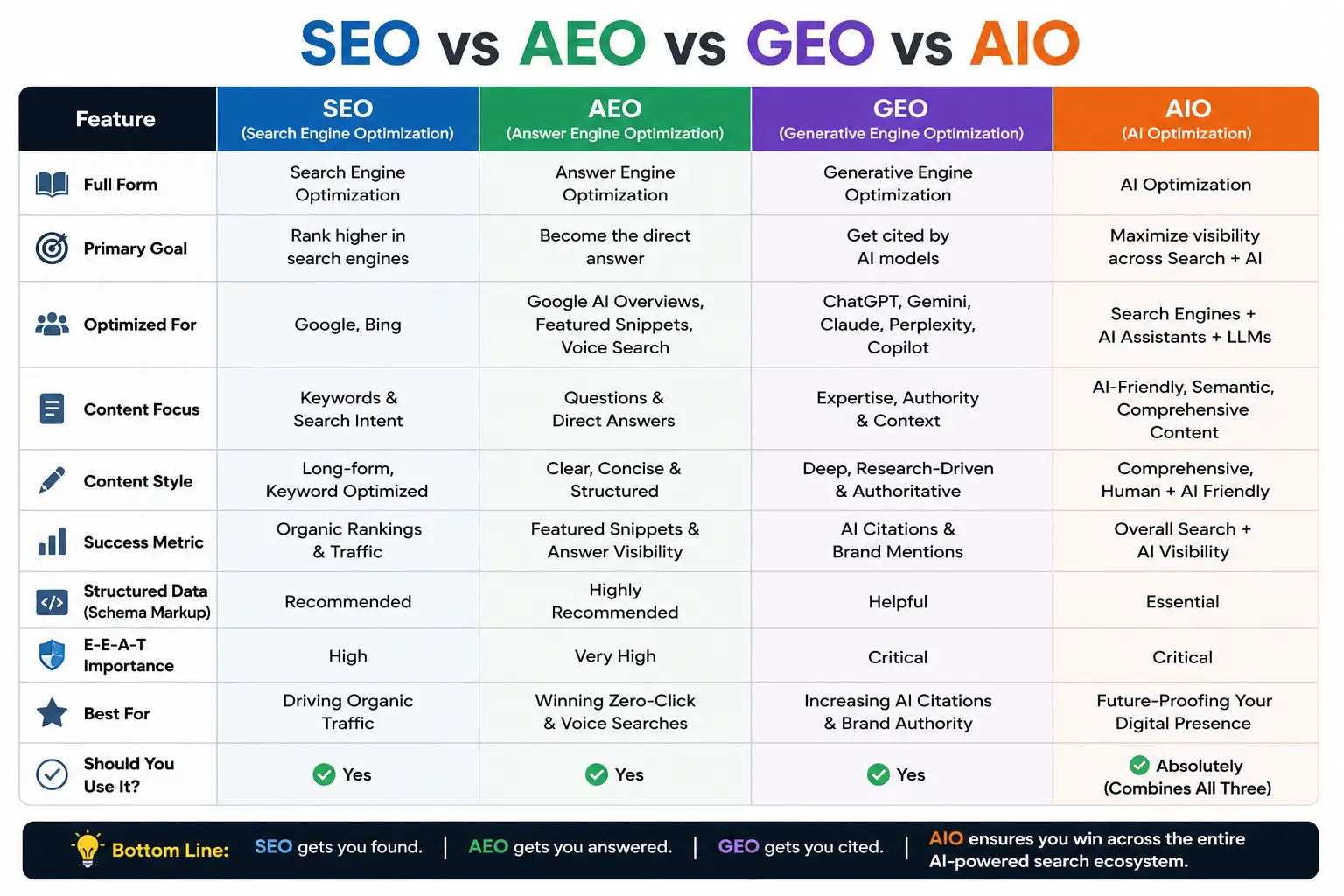
Quick Definitions: SEO vs AEO vs GEO vs AIO
| Full Form | What It Optimizes For | Where You Show Up | Goal | |
|---|---|---|---|---|
| SEO | Search Engine Optimization | Traditional ranking algorithms | Google/Bing results pages, blue links | Get a click |
| AEO | Answer Engine Optimization | Featured snippets, voice assistants, People Also Ask | Google AI Overviews, Alexa, Siri, Google Assistant | Get extracted as the direct answer |
| GEO | Generative Engine Optimization | LLM retrieval and citation behavior | ChatGPT, Perplexity, Gemini, Claude responses | Get cited or mentioned inside an AI-generated answer |
| AIO | AI (Overview) Optimization / AI Optimization | The entire AI-powered discovery ecosystem | All of the above, combined | Be visible and recommended everywhere AI mediates a decision |
Now let’s go through each one properly — what it actually means, and how to optimize for it.
1. SEO (Search Engine Optimization): Still the Foundation, Not the Whole House
SEO is the practice of making your content rank higher in traditional search engine results — Google, primarily. It’s built on keywords, technical structure, backlinks, and authority signals, and the goal has always been the same: show up in a list of results and win the click.
Is SEO dead? No — and anyone telling you that is either selling GEO consulting or hasn’t looked at their own analytics. SEO is still the foundation everything else is built on. AEO and GEO systems still crawl, index, and evaluate authority using SEO fundamentals; you can’t get cited by an AI model if that model’s retrieval system can’t find or trust your page in the first place.
How to optimize for SEO in 2026
- Technical health first. Crawlability, site speed, mobile experience, and clean indexing remain non-negotiable — AI systems that summarize or cite your content still need to be able to access it cleanly.
- Search intent over keyword density. Structure pages around what a searcher is actually trying to accomplish, not a keyword count.
- E-E-A-T signals. Experience, Expertise, Authoritativeness, and Trustworthiness increasingly decide whether any engine — traditional or AI — treats your content as citation-worthy.
- Internal linking. Connect related pages so both search crawlers and AI retrieval systems understand how your content fits together as a topic cluster, not isolated pages.
This is the layer covered by a proper AI SEO Services audit — technical fixes and keyword clustering, backed by real data rather than guesswork.
2. AEO (Answer Engine Optimization): Becoming the Answer, Not Just a Result
AEO is the practice of structuring content so it gets extracted as a direct answer — in Google’s featured snippets, AI Overviews, People Also Ask boxes, or voice assistant responses like Siri and Alexa. If SEO’s goal is “show up in the list,” AEO’s goal is “become the thing that gets read out loud or pasted at the top of the page.”
The two disciplines are closely related but ask different questions: GEO asks “how do I get cited in an AI-generated response?” AEO asks the more specific question: “how do I become the answer itself?”
How to optimize for AEO in 2026
- Answer the question in the first 2–3 sentences. Bury the direct answer under three paragraphs of preamble and you’ve already lost the snippet.
- Use structured formatting. Numbered lists, tables, and clearly labeled FAQ sections are dramatically more extractable than dense paragraphs — this is exactly why the FAQ section below this post is built the way it is.
- Target question-based queries directly. “What is AEO,” “how does AEO differ from SEO” — write for the literal question, not just the topic.
- Use FAQ schema markup. It signals to both Google and AI crawlers exactly which text answers which question, which is the single highest-leverage technical step for AEO.
- Optimize for voice search phrasing. Voice queries are longer and more conversational than typed ones (“what’s the difference between AEO and GEO” vs. “AEO vs GEO”) — write content that naturally answers both forms.
3. GEO (Generative Engine Optimization): Getting Cited Inside the Conversation
GEO is about how generative AI systems — ChatGPT, Perplexity, Gemini, Claude — synthesize and cite information when producing an answer. This is less about ranking a page and more about brand understanding: does the AI model know what your business does, when it should mention you, and how to describe you accurately?
If an AI system generates an answer about your industry and never mentions your brand, that’s a GEO gap — not an SEO one. Your site might rank fine on Google and still be functionally invisible inside ChatGPT.
A closely related term worth knowing: LLMO (Large Language Model Optimization) — the technical subset of GEO focused specifically on how LLMs retrieve and cite content through training data and retrieval-augmented generation (RAG) pipelines. If you’re doing GEO properly, you’re already doing most of LLMO.
How to optimize for GEO in 2026
- Entity-based clarity. Make it unambiguous what your brand is, does, and is known for — in your own words, consistently, across every page. AI models synthesize from patterns; inconsistent descriptions of your own business confuse that synthesis.
- Get cited by sources LLMs already trust. Wikipedia, industry publications, and reputable third-party sites feed AI training and retrieval far more than your own domain alone ever will.
- Publish original data and clear statements of fact. Generative engines favor content they can quote cleanly and attribute — vague marketing copy gets paraphrased away; specific, well-supported claims get cited.
- Structure content for extraction, not persuasion. Clear, declarative sentences (the way this post is written) are easier for an LLM to lift and cite accurately than clever, ambiguous copywriting.
- Monitor how AI models describe you. Periodically ask ChatGPT, Perplexity, and Gemini what they know about your brand — it’s the closest thing GEO has to a rank tracker right now.
4. AIO (AI Optimization): The Ecosystem View
AIO zooms out from any single platform and looks at the entire AI-powered discovery ecosystem shaping how people find, evaluate, and choose a business — AI Overviews, voice search, AI shopping assistants, and every emerging surface where AI mediates a decision before a human ever visits your website.
Worth a quick clarification, since this term gets used two ways: some use AIO specifically to mean Google’s AI Overviews feature (a subset of AEO), while others use it as the umbrella term for AI-powered optimization across the whole ecosystem, which is how this guide uses it. Both usages are common in 2026 — check context.
How to optimize for AIO in 2026
- Don’t optimize for one platform. A strategy built only for Google AI Overviews will underperform the moment a client asks Perplexity or ChatGPT the same question and gets a different answer about you.
- Audit your AI footprint quarterly, not annually — this landscape moves faster than a traditional SEO audit cycle ever needed to.
- Combine, don’t choose. The brands winning in 2026 aren’t picking one of these four; they’re building content that ranks (SEO), gets featured (AEO), gets cited (GEO), and shows up consistently across AI Overviews and assistants (AIO) — all from the same well-structured content base.
How These Four Actually Work Together
Think of it less as four strategies and more as four outcomes from one well-built content foundation:
- SEO gets your page found and trusted in the first place.
- AEO gets that trusted page extracted as a direct answer.
- GEO gets your brand cited and correctly described when an AI model generates a broader answer.
- AIO makes sure that visibility holds up consistently across every AI surface your customer might use — not just Google.
None of these replace SEO. They extend it. A page with weak technical SEO and thin authority signals won’t get cited by an LLM no matter how well-formatted its FAQ section is — the foundation still has to be solid.
A Practical Example: What This Looks Like in a Real Audit
When I run an AI SEO Services audit for a Delhi NCR client, this framework isn’t theoretical — it changes what gets prioritized in the first month:
- Week 1–2 (SEO layer): Technical crawl, indexing issues, page speed, and keyword clustering by real search intent using Semrush data.
- Week 3–4 (AEO layer): Restructuring key pages with direct-answer openings, FAQ schema, and content formatted for extraction rather than persuasion-only copy.
- Month 2 (GEO layer): Checking how ChatGPT, Perplexity, and Gemini currently describe the client’s brand and category, then publishing clearer, more citable statements of what the business does and who it serves.
- Ongoing (AIO layer): Monthly monitoring across Google AI Overviews and major AI assistants, not just a traditional rank tracker — the same “documented baseline, honest reporting” approach used across every AI Marketing Consulting engagement.
This is also exactly the kind of structural thinking behind a recent piece comparing ChatGPT vs. Claude for Marketing — the tools you use to produce content and the strategy you use to make that content discoverable by AI are two sides of the same 2026 marketing problem.
Trends Shaping SEO, AEO, GEO, and AIO Through the Rest of 2026
- Zero-click search keeps growing. With well over 60% of Google searches ending without a click, ranking #1 no longer guarantees traffic — being the cited answer matters as much as being the top result.
- Google AI Mode has scaled fast. It’s already reported to have over 2 billion monthly users across 200+ countries, making AEO and AIO no longer optional experiments but core visibility channels.
- GEO agencies and tooling are maturing quickly. What was a niche specialty in 2024 is now a standard line item in enterprise marketing budgets for 2026.
- The “rank high, get clicks” funnel is no longer the only funnel. Buying decisions increasingly form before a click happens, inside an AI-generated answer — meaning brand description accuracy inside AI systems now directly affects revenue.
- Structured, question-first content consistently outperforms. Across SEO, AEO, and GEO alike, the same pattern repeats: build for real people, structure for machines. That formula hasn’t changed across any era of search — it’s just being tested by more engines at once.
Frequently Asked Questions
1. What is the difference between SEO, AEO, GEO, and AIO?
SEO focuses on ranking web pages on traditional search engines like Google. AEO focuses on getting content extracted as a direct answer in snippets, voice search, and AI Overviews. GEO focuses on getting cited and accurately described inside generative AI responses from tools like ChatGPT and Perplexity. AIO is the umbrella term for optimizing visibility across the entire AI-powered discovery ecosystem, combining all three.
2. Is SEO still important in 2026, or has AEO and GEO replaced it?
SEO is still the foundation. AEO and GEO both depend on search engines and AI systems being able to crawl, index, and trust your content in the first place — neither replaces SEO, they extend it. Brands relying exclusively on old-style SEO risk losing visibility, but abandoning SEO for AEO or GEO alone would remove the foundation both depend on.
3. What is GEO (Generative Engine Optimization) in simple terms? GEO is the practice of structuring your content and brand information so generative AI tools like ChatGPT, Gemini, Claude, and Perplexity understand what you do and cite you accurately when generating an answer. It’s less about ranking a page and more about whether an AI model knows your brand exists and describes it correctly.
4. How do I optimize my website for AI Overviews and ChatGPT specifically?
Structure content to directly answer the question in the first few sentences, use FAQ schema markup, keep brand descriptions consistent and specific across every page, and get cited by third-party sources AI models already trust. This combination supports both AEO (Google AI Overviews, snippets) and GEO (ChatGPT, Perplexity, Gemini citations) at the same time.
5. What does AIO mean in digital marketing?
AIO most commonly refers to AI Optimization — the broader strategy of maintaining visibility across the full AI-powered discovery ecosystem, not just one platform. Some use it more narrowly to mean Google’s AI Overviews specifically; both usages are common in 2026, so context matters.
6. Which should a small business focus on first: SEO, AEO, or GEO?
Start with SEO fundamentals — technical health, keyword clustering by real intent, and authority building — since AEO and GEO both depend on that foundation. Layer in AEO next through FAQ structuring and direct-answer formatting, since it typically shows measurable movement faster than GEO. GEO monitoring and optimization can follow once the core content base is solid.
7. How long does it take to see results from AEO and GEO optimization?
Similar to SEO, meaningful movement typically takes a few months rather than weeks — Google and AI systems both need time to re-crawl, re-index, and re-evaluate trust signals. Most businesses see initial AEO movement (snippet appearances, AI Overview mentions) somewhat faster than GEO shifts (consistent, accurate citation inside LLM-generated answers), since GEO depends partly on retraining and retrieval cycles outside your direct control.
8. Can I do SEO, AEO, and GEO myself, or do I need a consultant?
Basic AEO steps (FAQ schema, direct-answer formatting) are DIY-friendly for a technically comfortable business owner. GEO monitoring and technical SEO audits typically benefit from professional tools like Semrush and hands-on experience reading the data correctly — this is where working with an experienced AI Marketing Consultant in Delhi or similar specialist usually accelerates results versus a fully DIY approach.
9. Does AEO and GEO optimization hurt traditional SEO rankings?
No — done correctly, they reinforce each other. Direct-answer formatting, FAQ schema, and clear entity descriptions are all things traditional SEO already rewards. There’s no meaningful tradeoff between optimizing for a human clicking a blue link and optimizing for an AI system extracting or citing that same well-structured content.
10. What’s the biggest mistake brands make with SEO vs AEO vs GEO vs AIO?
Treating them as competing strategies and picking one instead of building an integrated approach. The brands losing visibility in 2026 are the ones still optimizing purely for blue-link rankings while AI-mediated discovery keeps growing — and the brands overcorrecting by chasing GEO trends while neglecting basic technical SEO end up with nothing solid for either system to trust or cite.
Where This Leaves Your Strategy
None of these four acronyms are going away, and none of them work in isolation. The real 2026 playbook is one integrated content foundation — technically sound, clearly structured, and consistently described — that simultaneously earns a ranking, wins a snippet, gets cited by an AI model, and holds up across every assistant your customer might ask.
If you want a straight, honest read on where your site currently stands across all four — not just a traditional ranking report — that’s exactly what a proper audit through AI SEO Services is built to show, with a documented baseline and real monthly reporting, not guesswork. You can also get a quick, no-obligation starting point through the free Google Ads Budget Calculator or just start a conversation directly.