
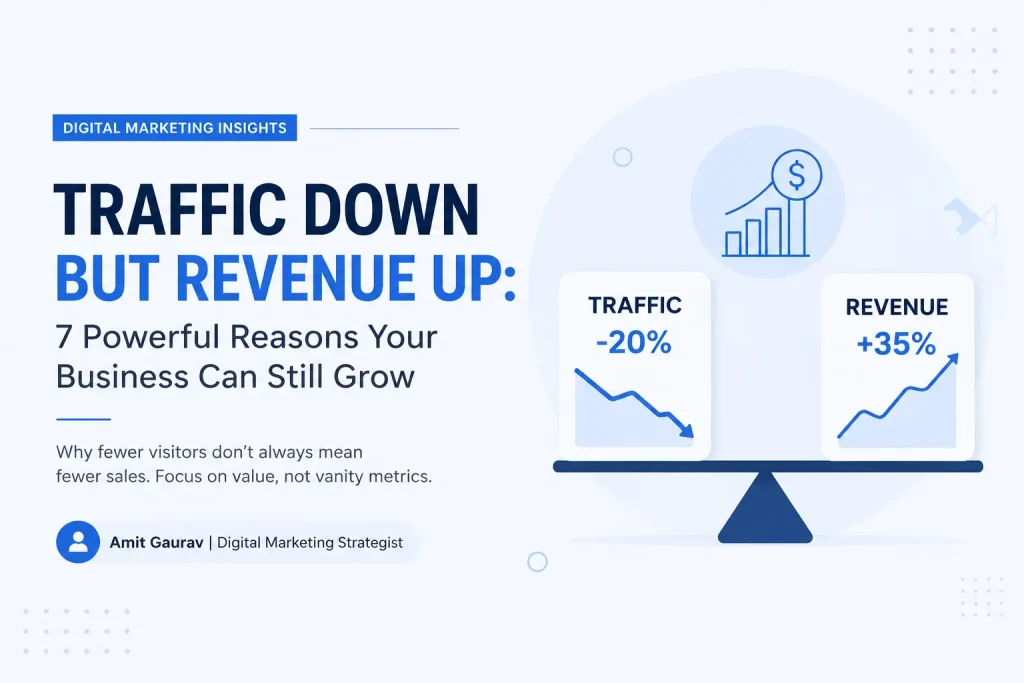
Traffic down but revenue up sounds like a contradiction.
If fewer people are visiting your website, how can the business possibly be making more money?
The answer is simple: website traffic is not the same thing as business value.
A company can lose traffic and still increase revenue when the traffic it retains has stronger buying intent, conversion rates improve, higher-value products perform better, customers become more valuable, or the business builds stronger brand demand across multiple channels.
That is why traffic down but revenue up should not automatically be treated as an SEO failure.
In fact, the situation can reveal something important about the quality of your digital marketing strategy.
A useful real-world example comes from NerdWallet. In Q4 2024, NerdWallet reported 19 million average monthly unique users, down 20% year over year, while quarterly revenue increased 37% to $183.8 million. The company said the traffic pressure was concentrated in non-monetizing “learn” topics and largely did not affect its product marketplaces or other channels.
That is the important distinction.
The lesson is not that traffic does not matter.
The lesson is:
Not every visitor has the same economic value.
And as SEO evolves into a broader search ecosystem involving Google Search, AI Overviews, AI Mode, ChatGPT, Gemini, Perplexity and other AI discovery experiences, understanding traffic quality is becoming more important than ever.
Quick Answer: Can Traffic Be Down While Revenue Is Up?
Yes. Traffic can decrease while revenue increases.
The most common reasons include:
- Higher-quality website visitors
- Stronger commercial search intent
- Higher conversion rates
- Increased average order value
- Better lead qualification
- Stronger brand demand
- More returning customers
- Growth in direct traffic
- Growth in paid or referral channels
- Better-performing products or services
- Improved sales funnels
- More efficient customer acquisition
For example, imagine a business receives 100,000 monthly visitors and generates ₹10 lakh in revenue.
The following year:
- Traffic falls to 80,000 visitors
- Conversion rate increases
- Higher-value customers become a larger share of sales
- Revenue increases to ₹13.5 lakh
Traffic has fallen 20%.
Revenue has increased 35%.
That business may actually have a better-performing acquisition system.
This is why the phrase traffic down but revenue up should trigger analysis rather than panic.
7 Reasons Traffic Down but Revenue Up Can Happen
1. Your Traffic Quality Has Improved
The first and most important reason for traffic down but revenue up is traffic quality.
Not every visitor arrives with the same intention.
Someone searching:
“What is digital marketing?”
is probably researching.
Someone searching:
“digital marketing consultant for startup”
has a much stronger commercial signal.
Both searches can generate organic traffic.
But the second visitor may be much closer to becoming a customer.
This is why businesses should stop treating every session as equally valuable.
A website can lose thousands of low-intent visitors while gaining hundreds of highly qualified visitors.
From an analytics perspective, traffic is down.
From a business perspective, demand quality may be improving.
A simple example
Imagine:
Before
- 100,000 visitors
- 2% conversion rate
- 2,000 conversions
After
- 80,000 visitors
- 3.5% conversion rate
- 2,800 conversions
Traffic fell by 20%.
Conversions increased by 40%.
That is a perfect example of traffic down but revenue up.
The right question is therefore not:
“Why did we lose visitors?”
It is:
“What type of visitors did we lose?”
2. Your Website May Be Losing Informational Traffic but Keeping Commercial Traffic
This is closely connected to search intent.
Most websites have a mixture of:
- Informational pages
- Commercial pages
- Transactional pages
- Brand pages
- Product pages
- Service pages
- Comparison pages
- Educational content
These pages do not have equal revenue potential.
An article explaining:
“What is SEO?”
might attract thousands of visitors.
A page targeting:
“SEO consultant in Delhi”
might attract far fewer.
But the second page could generate considerably more business.
This is why traffic down but revenue up can be a sign that the traffic mix has changed.
The website may be receiving fewer broad informational searches while maintaining or increasing visibility for high-intent searches.
NerdWallet’s Q4 2024 reporting provides a useful example. The company said traffic headwinds worsened in non-monetizing “learn” topics while largely not affecting its product marketplaces and other channels. At the same time, Q4 revenue increased 37% year over year.
The lesson for SEO professionals is important:
Do not evaluate every lost visitor equally.
Evaluate the business value of the visitor.
3. Your Conversion Rate May Have Improved
Another major reason for traffic down but revenue up is conversion rate optimization.
Conversion rate is:
Conversions ÷ Visitors × 100
Suppose your website gets:
100,000 visitors and converts 2% of them.
That produces:
2,000 conversions.
Now traffic falls to:
80,000 visitors.
But your conversion rate improves to:
3.5%.
You now have:
2,800 conversions.
You lost 20,000 visitors.
But you gained 800 additional conversions.
This is why conversion optimization can sometimes create more business value than simply acquiring additional traffic.
Your website may be improving because of:
- Better landing pages
- Clearer CTAs
- Faster page speed
- Better mobile UX
- Stronger trust signals
- Better pricing
- Better offers
- Better forms
- Stronger testimonials
- Better product positioning
- Improved sales follow-up
A digital marketing strategy should therefore connect SEO with conversion optimization, rather than treating them as completely separate activities.
Amit Gaurav’s own digital marketing content emphasizes this relationship: traffic generation is only part of the process, while conversion optimization determines whether that traffic turns into leads and sales.
4. Your Brand Is Becoming Stronger
Brand demand can completely change the economics of website traffic.
When people do not know your company, they may discover you through generic searches.
But once your brand becomes recognizable, people may start searching for you directly.
The journey changes from:
“digital marketing consultant”
to:
“Amit Gaurav digital marketing consultant”
That is a major shift.
The user is no longer simply searching for a category.
They are searching for a specific entity.
Strong brands can generate:
- Branded Google searches
- Direct visits
- Repeat visits
- Referrals
- Social discovery
- Email traffic
- Podcast discovery
- LinkedIn discovery
- AI recommendations
- Word-of-mouth demand
This is one reason why traffic down but revenue up can sometimes happen when a business becomes more brand-driven.
The business may receive fewer generic visitors while generating more demand from people who already understand the brand.
Brand does not replace SEO.
It makes SEO more powerful.
5. Higher-Value Products or Services Are Driving Revenue
Revenue does not depend only on how many people visit.
It also depends on what they buy.
Imagine an ecommerce website loses 20% of its visitors but sees more customers purchasing premium products.
Traffic falls.
Average order value increases.
Revenue can still rise.
The same applies to service businesses.
Suppose a digital marketing consultant previously generated many small ₹10,000 projects.
Later, the business attracts fewer but larger clients worth ₹1 lakh or ₹2 lakh.
Website traffic may decline.
Lead volume may even decline.
But revenue can increase significantly.
This is why marketers should track:
- Average order value
- Average deal size
- Customer lifetime value
- Revenue per lead
- Revenue per customer
- Qualified lead rate
- Sales conversion rate
If these metrics improve, a traffic decline may not be as dangerous as it appears.
6. Other Marketing Channels May Be Replacing Lost Search Traffic
Your business does not live inside Google Analytics’ “Organic Search” channel.
Customers can discover you through:
- Google Search
- Google AI features
- YouTube
- Referrals
- Podcasts
- Communities
- Paid advertising
- Partnerships
- Direct visits
- Word of mouth
- AI search platforms
Suppose organic traffic declines 20%.
But:
- Direct traffic increases 15%
- Referral traffic increases 20%
- LinkedIn generates more leads
- Paid search becomes more efficient
- Returning customers increase
Your total business performance could still improve.
This is why channel-level analysis matters.
A decline in one channel does not automatically mean a decline in demand.
It may mean demand is moving.
7. Search Is Changing, Especially With AI
This is the biggest reason marketers need to rethink the traffic conversation.
Traditional search largely followed this model:
Search → Result → Click → Website
AI-powered search introduces another layer:
Question → AI answer → Sources/recommendations → Brand discovery → Website or conversion
Google’s current documentation says AI Overviews and AI Mode continue to use Google’s existing Search systems and that the foundational SEO best practices remain relevant. Google also says there are no special additional technical requirements for appearing in these AI features beyond being eligible for Search.
That means businesses should not chase mythical “AI SEO tricks.”
They should focus on:
- Helpful content
- Strong technical SEO
- Clear expertise
- Original insights
- Strong internal linking
- Search intent
- Good page experience
- Crawlability
- Structured information
- Brand authority
Google’s latest generative-AI guidance specifically emphasizes unique, valuable, non-commodity content and original viewpoints rather than simply recycling information already available online.
What Does AI Search Mean for Traffic?
AI search creates an interesting measurement problem.
A user might ask:
“Who are the best digital marketing experts in India?”
An AI system may mention several experts.
The user might not click immediately.
But they may remember one name.
Later, they may search that name directly.
That first discovery may have influenced the eventual conversion.
So the customer journey could become:
AI discovery → brand recognition → branded search → website → conversion
Traditional analytics may not always make the complete journey obvious.
This is why AI visibility should be considered alongside traditional organic traffic.
Google has now introduced a Generative AI performance report in Search Console, showing impressions from generative AI features including AI Overviews and AI Mode. The report is being rolled out gradually to website owners.
This is an important development.
Search visibility is becoming broader than traditional blue-link rankings.
Traffic Down but Revenue Up: The Metric That Matters More
One of the simplest ways to understand traffic quality is:
Revenue Per Visitor
The formula is:
Revenue Per Visitor = Total Revenue ÷ Total Visitors
Imagine:
Year 1
100,000 visitors
₹10 lakh revenue
Revenue per visitor = ₹10
Year 2
80,000 visitors
₹13.5 lakh revenue
Revenue per visitor = ₹16.88
Traffic fell 20%.
Revenue increased 35%.
Revenue per visitor increased by almost 69%.
That is a dramatic improvement in traffic efficiency.
Of course, revenue per visitor should not replace other metrics.
You still need to consider:
- Customer acquisition cost
- Profit margin
- Customer lifetime value
- Conversion rate
- Lead quality
- Attribution
- Sales cycle
But this metric immediately demonstrates why traffic volume alone can be misleading.
Traffic vs Revenue: Which One Should You Optimize?
This is the wrong question:
“Should we optimize traffic or revenue?”
The better question is:
“How do we attract more valuable traffic that produces more revenue?”
Traffic is still important.
Without visitors, there are fewer opportunities.
But the objective of digital marketing should be to create a chain:
Visibility → Traffic → Intent → Trust → Conversion → Revenue
If one part improves while another declines, the final business result can still improve.
For example:
Traffic ↓
Intent ↑
Trust ↑
Conversion ↑
Revenue ↑
That is not necessarily a failing marketing system.
It may be an improving one.
How to Diagnose Traffic Down but Revenue Up
If your analytics dashboard shows traffic down but revenue up, do not immediately publish more content or start chasing high-volume keywords.
Follow this process.
Step 1: Find Which Pages Lost Traffic
Look at:
- Top landing pages
- Organic landing pages
- Blog posts
- Service pages
- Product pages
- Category pages
Identify exactly where the decline happened.
A 20% decline on informational blog posts is very different from a 20% decline on your highest-converting service pages.
Step 2: Analyze Search Intent
Classify lost keywords into:
Informational
“What is SEO?”
Commercial
“Best SEO agency”
Transactional
“Hire SEO consultant”
Navigational
“Amit Gaurav”
This tells you whether the lost traffic represented awareness, consideration, purchase intent or brand demand.
Step 3: Compare Traffic With Conversions
Do not stop at sessions.
Compare:
- Visitors
- Leads
- Sales
- Conversion rate
- Revenue
- Revenue per visitor
If traffic decreases but qualified leads increase, investigate why.
You may have improved traffic quality.
Step 4: Separate Brand and Non-Brand Traffic
This is especially important for personal brands.
Track searches containing your name separately from generic searches.
For Amit Gaurav, examples could include:
“Amit Gaurav”
“Amit Gaurav SEO”
“Amit Gaurav digital marketing”
“Amit Gaurav AI marketing”
Branded demand can be a useful indicator of growing recognition.
Should You Try to Recover Every Lost Visitor?
No.
This is one of the biggest mistakes marketers make.
Suppose you lose 50,000 monthly visitors.
The instinct is:
“We need to recover those 50,000 visitors.”
But ask:
“What did those visitors actually generate?”
If they produced:
- Almost no leads
- Almost no sales
- Low engagement
- Low customer value
then recovering all of them may not be the best use of your marketing resources.
But if those visitors generated:
- High-value leads
- Sales
- Strong assisted conversions
- Significant revenue
then the decline requires urgent attention.
The correct strategy is:
Diagnose value first. Recover traffic second.
Why High-Intent Keywords Can Beat High-Volume Keywords
Imagine these two keywords.
Keyword A
10,000 monthly searches
Conversion rate: 0.2%
Keyword B
1,000 monthly searches
Conversion rate: 5%
Keyword A looks much better in an SEO report.
Keyword B could be far more valuable to the business.
This is why keyword research should not focus only on:
- Search volume
- Keyword difficulty
- Rankings
You should also consider:
- Search intent
- Commercial value
- Customer relevance
- Conversion potential
- Revenue potential
- Brand relevance
The goal is not to rank for everything.
The goal is to rank for the searches that matter.
What Businesses Should Measure in 2026
A modern digital marketing dashboard should include more than sessions.
Track:
1. Organic traffic
Still important.
2. Qualified organic traffic
More useful than total traffic.
3. Commercial keyword visibility
Shows whether you are visible closer to the buying decision.
4. Conversion rate
Shows how effectively traffic turns into action.
5. Qualified leads
More useful than raw form submissions.
6. Revenue
The ultimate commercial outcome.
7. Revenue per visitor
Shows traffic efficiency.
8. Customer acquisition cost
Shows marketing efficiency.
9. Customer lifetime value
Shows long-term customer economics.
10. Brand searches
Shows whether people are actively looking for you.
11. Direct traffic
Useful for understanding returning and brand-driven demand.
12. AI search visibility
Google’s new Search Console generative-AI reporting can provide visibility into impressions from AI Overviews and AI Mode for sites included in the rollout.
A Better SEO Framework for the AI Search Era
For modern SEO, I recommend thinking beyond:
Rankings → Traffic
Instead:
Discoverability
Can search engines and AI systems find your content?
Relevance
Does the content answer the actual search intent?
Expertise
Does the page demonstrate real knowledge?
Authority
Do other sources recognize or reference your expertise?
Brand
Does the audience remember who you are?
Conversion
Does the visitor take meaningful action?
Revenue
Does the overall system create business value?
This is especially relevant to personal brands.
For Amit Gaurav, the long-term opportunity is not simply to rank for “digital marketing.”
It is to build a connected entity around:
Amit Gaurav + Digital Marketing + SEO + AI Marketing + GEO + AEO + Performance Marketing + Digital Growth
That creates a stronger foundation for Google visibility and AI discovery.
How Brand, SEO and AI Search Work Together
Think of the modern customer journey like this:
SEO
Helps people discover you.
↓
Content
Demonstrates expertise.
↓
Brand
Makes you memorable.
↓
AI Search
Creates additional discovery and recommendation opportunities.
↓
Trust
Reduces buying hesitation.
↓
Conversion
Turns attention into action.
↓
Revenue
Creates measurable business value.
This is why I would not recommend choosing between SEO and brand.
You need both.
And increasingly, you need content that works across both traditional search and AI-driven discovery.
The NerdWallet Lesson Marketers Should Actually Remember
The NerdWallet example is valuable because it challenges the assumption that user volume and revenue always move together.
In Q4 2024:
- Monthly unique users were down 20%
- Revenue was up 37%
- Revenue reached $183.8 million
- The company said traffic pressure was concentrated in non-monetizing “learn” topics
- Insurance revenue grew strongly
- Banking contributed to growth in emerging verticals
- Credit-card revenue still faced organic-search headwinds
That means the story is more nuanced than:
“NerdWallet lost traffic and focused on branding.”
A more accurate interpretation is:
Some traffic declined, particularly lower-monetizing informational traffic, while revenue-producing areas and other channels remained stronger.
That is a much more useful SEO lesson.
Never confuse audience volume with audience value.
Don’t Use Traffic as a Vanity Metric
Traffic is useful.
But traffic can become a vanity metric when marketers celebrate it without understanding its commercial contribution.
Ask these questions every month:
Did qualified traffic increase?
Did conversions increase?
Did revenue increase?
Did revenue per visitor improve?
Did brand searches increase?
Did commercial keyword visibility improve?
Did customer acquisition become more efficient?
Did our content become more useful and authoritative?
Those questions produce much better strategic decisions.
What If Traffic Is Down and Revenue Is Also Down?
This is different.
If you have:
Traffic ↓
Conversions ↓
Revenue ↓
then you probably have a genuine acquisition or conversion problem.
Investigate:
- Ranking losses
- Technical SEO
- Search intent changes
- Competitor activity
- Content quality
- Algorithm changes
- Conversion friction
- Product-market fit
- Pricing
- Brand demand
- Channel performance
The key is not to assume the solution is always “more traffic.”
You might have a conversion problem.
You might have an offer problem.
You might have a positioning problem.
You might have a search visibility problem.
Diagnose before prescribing.
What If Traffic Is Down but Leads and Revenue Are Up?
That is a completely different situation.
You may have:
Traffic ↓
Qualified leads ↑
Conversion rate ↑
Revenue ↑
In that case, your traffic strategy may actually be becoming more efficient.
Do not automatically undo the change simply because your traffic graph looks smaller.
Instead, identify what caused the improvement.
Was it:
- Better keyword targeting?
- Better landing pages?
- Stronger brand?
- Better audience targeting?
- Higher-value products?
- Improved sales process?
- Better conversion optimization?
Then invest more in what is working.
The Future of SEO Is Not About Maximum Traffic
The future of SEO is about maximum valuable visibility.
That means being visible when your ideal customer asks an important question.
It means appearing for the right commercial searches.
It means building topical authority.
It means creating original content.
It means earning citations and mentions.
It means becoming recognizable as an expert.
It means appearing across traditional search and AI-powered discovery.
Google’s current guidance is very clear that there is no separate magic optimization required for AI Overviews or AI Mode. The same foundational SEO principles still matter: technical accessibility, helpful content, internal links, good page experience and accurate structured data.
Google’s generative-AI guidance also emphasizes original, valuable and non-commodity content rather than mass-producing pages simply to capture search traffic.
That is good news.
The fundamentals still matter.
But the definition of visibility is expanding.
Traffic Down but Revenue Up: What Should You Do Next?
If your business is experiencing traffic down but revenue up, do not immediately celebrate either.
Investigate.
You need to know whether the improvement is sustainable.
Check:
Traffic quality
Did you lose low-value visitors?
Search intent
Are commercial visitors becoming a larger percentage of traffic?
Conversion rate
Are more visitors becoming customers?
Customer value
Are customers spending more?
Brand demand
Are more people searching specifically for your brand?
Channel diversification
Are direct, referral, paid, social or AI-driven sources growing?
SEO visibility
Are you still visible for strategically important searches?
AI visibility
Are your pages appearing in AI-generated search experiences?
Google’s new generative-AI performance reporting is designed to help site owners understand impressions from AI features such as AI Overviews and AI Mode, although availability is still being rolled out.
Final Takeaway
Traffic down but revenue up is not a contradiction.
It is a reminder that digital marketing is more complicated than a single traffic graph.
You can lose visitors and gain customers.
You can lose rankings for informational searches and increase commercial demand.
You can receive fewer sessions and generate more revenue.
You can lose clicks from one channel while gaining customers through another.
And you can become more valuable as a brand even when raw traffic becomes harder to measure.
The NerdWallet example demonstrates exactly why marketers need to look beyond traffic volume. In Q4 2024, monthly unique users declined 20%, while revenue increased 37% to $183.8 million. NerdWallet specifically said the traffic pressure was concentrated in non-monetizing “learn” topics and largely did not affect its product marketplaces and other channels.
The lesson for SEO is simple:
Don’t optimize for traffic alone.
Optimize for:
Visibility → Intent → Trust → Conversion → Revenue
Build content that deserves to rank.
Build content that AI systems can understand.
Build a brand people remember.
Target searches with genuine business value.
Improve your conversion process.
Measure revenue, not just sessions.
And when your traffic graph goes down, don’t automatically assume your marketing has failed.
Sometimes the better question is:
Did we lose traffic, or did we lose valuable demand?
Those are not the same thing.
And understanding the difference could completely change how you approach SEO, AI search, digital marketing and business growth.
Frequently Asked Questions
1. Can traffic be down but revenue still increase?
Yes. Traffic can be down while revenue increases when the visitors who remain are more valuable or the business becomes more effective at converting them. A website might lose large amounts of low-intent informational traffic while retaining high-intent commercial visitors. Revenue can also grow because of higher conversion rates, larger average order values, better customer retention, stronger products, improved pricing, or growth in other acquisition channels. Therefore, a traffic decline should always be analyzed alongside leads, conversions, revenue per visitor, customer value and channel performance before deciding whether it is actually harmful.
2. Why is my website traffic down but sales are up?
Your website traffic may be down while sales are up because the quality of your traffic has improved. You may have lost visitors from broad informational keywords while maintaining or increasing traffic from commercial and transactional searches. Your website may also have improved its conversion rate through better landing pages, stronger calls to action, better offers, improved user experience, or clearer messaging. Another possibility is that customers are discovering your business through direct, referral, social, paid, email or other channels. The important thing is to compare traffic with qualified leads, conversion rate, sales and revenue.
3. Is a 20% drop in organic traffic always bad for SEO?
No. A 20% drop in organic traffic deserves investigation, but it is not automatically an SEO failure. First determine which pages and keywords lost traffic and what type of intent they represented. Losing traffic from informational articles may have a very different commercial impact from losing visibility on product or service pages. You should then compare organic traffic with qualified leads, conversions, revenue and revenue per visitor. If valuable traffic and revenue remain stable or increase, the decline may represent a change in traffic composition rather than a fundamental deterioration of your business.
4. What should I do when traffic is down but revenue is up?
When traffic is down but revenue is up, do not immediately try to recover every lost visitor. First identify exactly where the traffic decline occurred and whether those visitors were generating meaningful business value. Compare branded and non-branded traffic, informational and commercial queries, landing pages, conversion rates, average order value and revenue per visitor. Then examine other channels such as direct, referral, social, paid search and email. If the business is becoming more efficient, protect the factors driving that efficiency while continuing to improve qualified search visibility and brand demand.
5. Is traffic quality more important than traffic quantity?
For most commercial businesses, traffic quality is more important than traffic quantity when evaluating business impact. A large audience is useful, but visitors who have no interest in your products or services may create very little economic value. A smaller audience with strong commercial intent can generate more leads and revenue. Quality can be evaluated using search intent, conversion rate, lead quality, revenue per visitor, customer acquisition cost and customer lifetime value. The ideal strategy is not to choose between quality and quantity, but to increase traffic while progressively improving the proportion of visitors who can become valuable customers.
6. Can branding help a business survive declining Google traffic?
Yes, a strong brand can reduce dependence on any single traffic source, including Google Search. When people recognize a company, they can discover and return to it through branded searches, direct visits, social media, email, referrals, communities, podcasts and recommendations. Brand recognition can also improve trust when someone encounters the business through search or an AI-generated answer. However, branding should complement SEO rather than replace it. SEO captures existing demand, while brand building creates recognition and preference. Together, they create a more diversified acquisition system that can remain resilient as search behavior changes.
7. Does AI search make website traffic less important?
AI search does not make website traffic irrelevant, but it changes how businesses should interpret visibility. A person may discover a company, expert or website through an AI-generated answer before deciding whether to visit the original site. Google says AI Overviews and AI Mode continue to use foundational Search systems and that standard SEO best practices remain important for eligibility and visibility. This means marketers should continue measuring organic traffic while also examining brand searches, conversions, referral sources and visibility within generative AI features. The customer journey may now contain more discovery steps before the final website visit.
8. Can AI Overviews reduce traffic but still help a brand?
Yes, although the effect can vary by query and website. AI Overviews can answer questions directly while also displaying links to supporting websites. Google says AI features are designed to help people explore information and discover relevant web content, and it has introduced Search Console reporting for impressions from generative AI features such as AI Overviews and AI Mode. A brand may therefore gain visibility even when every impression does not result in a traditional click. Marketers should evaluate AI visibility alongside traffic, branded searches, qualified referrals and conversions rather than treating clicks as the only outcome.
9. Should I stop creating informational content if it doesn’t generate direct revenue?
No. Informational content can still create substantial strategic value even when it does not immediately generate a sale. It can introduce people to your brand, demonstrate expertise, build topical authority, earn links, support commercial pages and influence future buying decisions. The problem is producing informational content without understanding its purpose or connection to the customer journey. Strong informational content should answer genuine audience questions and connect naturally to relevant resources, services or products. Google’s current guidance emphasizes helpful, reliable, original, people-first content rather than content created primarily to generate search traffic.
10. How can I increase revenue without increasing website traffic?
You can increase revenue without increasing traffic by improving the value and conversion efficiency of the visitors you already receive. Focus on conversion rate optimization, better landing pages, stronger offers, clearer calls to action, improved trust signals, higher average order value, better lead qualification and more effective sales follow-up. You can also prioritize traffic sources and keywords that consistently produce higher-value customers. Increasing revenue per visitor can sometimes be more efficient than continuously trying to increase total traffic. The key is to identify where customers are already converting and then improve that part of the funnel.
11. What is revenue per visitor and why should marketers track it?
Revenue per visitor is a simple measurement of how much revenue a website generates relative to its visitor volume. The formula is total revenue divided by total visitors. For example, ₹10 lakh in revenue from 100,000 visitors equals ₹10 revenue per visitor. If traffic falls to 80,000 while revenue increases to ₹13.5 lakh, revenue per visitor rises substantially. This metric helps marketers understand whether traffic is becoming more economically valuable. It should not replace conversion rate, customer acquisition cost or customer lifetime value, but it is an effective supporting metric for evaluating traffic quality and efficiency.
12. How should I measure SEO when traffic is declining?
Measure SEO using a combination of visibility, quality and business metrics. Start with organic traffic, but segment it by brand, non-brand, search intent, landing page, country and device where relevant. Then track rankings for commercially important keywords, qualified leads, conversion rates, sales, revenue and revenue per visitor. Also monitor branded search demand and other acquisition channels. For AI search, Google now provides a Generative AI performance report in Search Console for participating sites, including impressions from AI Overviews and AI Mode. This broader measurement framework gives a much more accurate picture of SEO performance.
13. Should businesses target high-volume keywords or high-intent keywords?
Businesses should generally prioritize a balance, but high-intent keywords often have greater direct commercial value. A high-volume informational keyword may attract thousands of visitors but generate very few leads, while a lower-volume commercial keyword can attract fewer people who are much closer to purchasing. The right strategy depends on the business model, sales cycle and customer journey. Use informational topics to build awareness and topical authority, while deliberately developing commercial and transactional content that captures demand closer to conversion. Keyword volume should be considered alongside search intent, relevance, competition, conversion potential and customer value.
14. What is the biggest mistake marketers make when traffic drops?
The biggest mistake is assuming that the solution is automatically “more traffic.” Marketers sometimes respond to a decline by publishing large quantities of new content or chasing high-volume keywords without understanding what caused the traffic loss. This can create even more low-value visitors without improving revenue. A better approach is to identify which pages and queries lost visibility, classify the lost traffic by intent, examine conversion and revenue data, and determine whether valuable demand actually declined. Once you understand the economic impact, you can decide whether the right solution is SEO recovery, conversion optimization, brand building or channel diversification.
15. How does search intent affect website revenue?
Search intent strongly influences the commercial value of website traffic. Informational searches usually indicate that someone wants to learn, while commercial searches often indicate that someone is comparing solutions, providers or products. Transactional searches can be even closer to a purchase decision. A website that attracts large volumes of informational traffic may therefore generate less revenue than a smaller site attracting highly relevant commercial visitors. Effective SEO should map content to different stages of the customer journey and ensure that high-intent searches have strong landing pages capable of converting qualified visitors into leads or customers.
16. Can losing low-value traffic actually improve marketing efficiency?
Yes, losing low-value traffic can sometimes improve marketing efficiency, although marketers should never assume that traffic is low value without evidence. If a website loses visitors who rarely convert while retaining or increasing visitors who generate leads and revenue, overall efficiency can improve. The right way to evaluate this is by comparing traffic segments against conversion rates, revenue per visitor, customer acquisition cost, assisted conversions and customer lifetime value. Businesses should not intentionally pursue traffic losses, but they should also avoid wasting resources trying to recover visitors that contribute little to the business.
17. What should I check if traffic is down but leads are increasing?
If traffic is down but leads are increasing, examine what changed in the quality and composition of your visitors. Compare conversion rates before and after the traffic decline, then identify which landing pages and queries are generating the additional leads. Check whether informational traffic declined while commercial traffic remained stable or increased. Also investigate changes in calls to action, landing-page design, forms, pricing, offers and sales qualification. If qualified leads are increasing, the traffic decline may actually indicate a shift toward more valuable demand. Protect the improvements that created the stronger conversion performance before trying to recover lost traffic.
18. What should a modern SEO strategy focus on in the AI search era?
A modern SEO strategy should focus on strong technical foundations, helpful content, original expertise, search intent, internal linking, brand authority and content that provides genuine value beyond generic summaries. Google’s current guidance says there are no special technical requirements or special AI schema required for AI Overviews or AI Mode beyond normal Search eligibility and SEO fundamentals. Google also recommends creating unique, valuable and non-commodity content that offers original perspectives and satisfies users. The goal should therefore be to become a trusted, understandable source across both traditional search and AI-powered discovery.
19. Does branded search matter if organic traffic is declining?
Yes. Branded search can provide an important signal of growing awareness and demand, particularly for personal brands and businesses that sell expertise or higher-consideration products. If people increasingly search for your name or company rather than generic category terms, they may already recognize you and have greater trust or intent. However, branded search should not be used to hide a serious decline in non-brand visibility. Track both separately. The ideal situation is growing branded demand combined with strong non-branded search visibility, because that creates both discovery from new audiences and preference among people who already know the brand.
20. What is the real lesson behind traffic down but revenue up?
The real lesson is that traffic is an input, not the final definition of digital marketing success. A business can lose visitors while improving search intent, conversion rate, customer value, brand strength and revenue. The NerdWallet example illustrates this clearly: in Q4 2024, monthly unique users declined 20% while revenue increased 37%, with the company explaining that traffic pressure was concentrated in non-monetizing “learn” topics while product marketplaces and other channels were more resilient. The right goal is therefore valuable visibility that creates qualified demand, trust, conversions and sustainable revenue.
Conclusion: Measure the Business, Not Just the Traffic
The next time your SEO report says:
Traffic down 20%.
Don’t immediately conclude:
“SEO is failing.”
Ask:
Which traffic disappeared?
Was it valuable?
Did commercial traffic change?
Did conversion rates improve?
Did revenue per visitor increase?
Did branded demand grow?
Did another channel replace the lost traffic?
Did AI search become part of the discovery journey?
These questions give you the real story.
The goal of SEO is not to create the biggest possible traffic number.
The goal is to create valuable visibility.
Visibility that reaches the right audience.
Content that demonstrates expertise.
Brand authority that creates trust.
Search visibility that generates qualified demand.
And a digital marketing system that ultimately contributes to revenue.
So yes:
Traffic down but revenue up can absolutely happen.
And when it does, don’t automatically try to get every lost visitor back.
First understand why the traffic declined and what happened to the value of the traffic that remained.
Because in modern digital marketing:
More traffic is not always more growth.
Better traffic can be.
And ultimately:
Revenue is the scoreboard.